

The only seabirds in Britain it's legal to kill
Posted 6th August 2026
Standing on the Bass Rock
I was standing on the Bass Rock surrounded by thousands of gannets when the NatureScot decision to postpone this year’s guga hunt came through. The Bass Rock is an iconic steeply cliffed island just off North Berwick, on the East Lothian coast. It is home to one of the world’s biggest gannet colonies. Until five years ago, it was the biggest.
My guide for the day was the admirable Maggie Sneddon from the Scottish Sea Bird Centre. Maggie has been guiding on the Bass Rock for more years than she cares to remember. She told me that the Rock is a fragile ecosystem that’s been under much pressure in recent years. Avian flu, sea warming and (other) man made threats such as discarded fishing tackle, combine to threaten individual gannets and the whole colony.
I was on the Bass Rock that day to film the gannets and their chicks – known as guga in Gaelic. Guga is also a word that has become resonant with controversy in the past year or so.
For centuries men from the district of Ness, on the Isle of Lewis, have made the forty-mile journey to Sula Sgeir, a remote rocky outcrop in the North Atlantic to “harvest” thousands of guga. Originally, the hunt provided a much-needed source of protein for the community. As the centuries passed and food security increased the hunt became an ancient tradition that speaks to folk in Ness of their connection to the sea and their island. Over the years, instead of being an important food source, the guga became a delicacy.

League Against Cruel Sports' Director of Scotland and Northern Ireland, Robbie Marsland
Meanwhile, conservation legislation began to respond to growing natural and man-made threats. By the beginning of the 1980s, all sea bird species were “protected” everywhere in the UK and it was an offence to kill them. That is, all species except one species and everywhere except one place. Gannets on Sula Sgeir were the only birds in the only place which escaped protection from the legislation.
The hunt on Sula Sgeir became licensed by what is now NatureScot. The only way that a license to kill around 2,000 gannet chicks a year could be refused, they said, was on conservation grounds. And so, for years that number of birds were killed each year.
Avian flu had a terrible impact on many sea bird populations, including gannets, in the years after 2020. Licenses to kill guga were not issued. The global Covid pandemic also made it impossible for the journey to Sula Sgeir to be made. No gannets were killed between 2020 and 2024. In 2025, a new application was made, and NatureScot agreed a reduced quota of 500 birds.
By then, many of the “old hands” had retired from the hunt and the new group decided to ditch most of the traditional aspects of the hunt. Rather than staying communally on Sula Sgeir for two weeks they made what was described as a “raid” and spent a day on the Island killing the quota of 500 birds and returning to Ness harbour to process and salt them there.
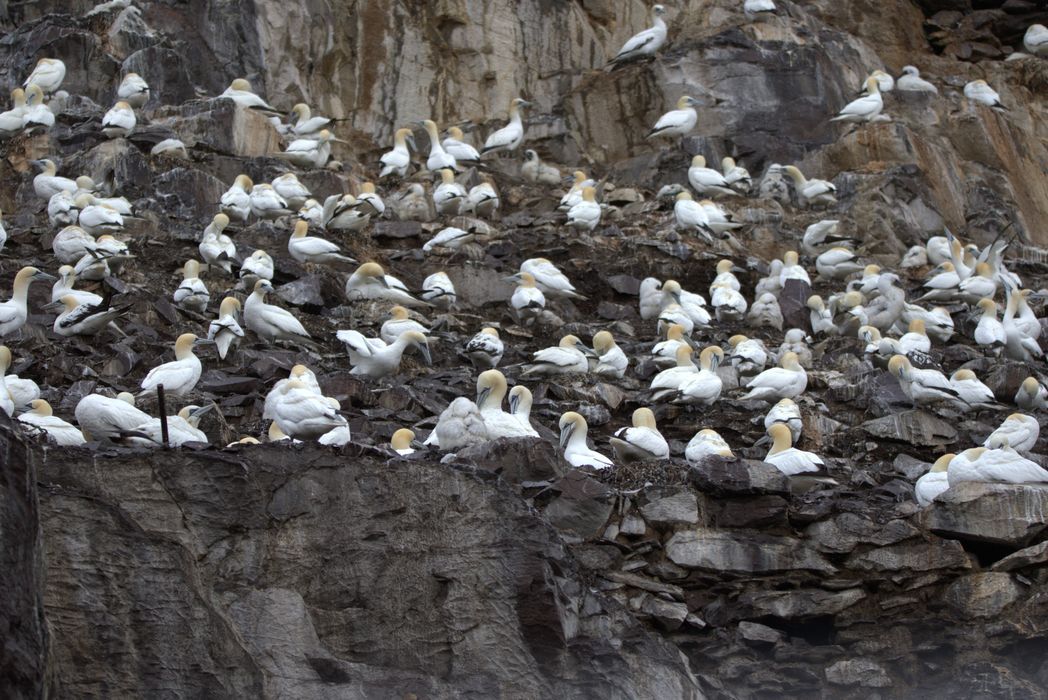
Gannets and their chicks, or 'guga', at Bass Rock
2020-2025
Avian flu had a terrible impact on many seabird populations, including gannets, and in 2020 Covid made the journey to Sula Sgeir impossible. Between 2020 and 2024, no licences were sought or issued, and no guga were killed.
In 2025, a new application was made, and NatureScot agreed a reduced quota of 500 birds.
By then, many of the ‘old hands’ had retired and the new group decided to ditch most of the traditional aspects of the hunt. Rather than staying communally on Sula Sgeir for two weeks they made what was described as a “raid” and spent a day on the island killing the quota of 500 birds and returning to Ness harbour to process and salt them there.
All hell broke loose.
International media piled in. A parliamentary petition against the hunt was launched which now stands at way over 100,000 signatures. Separately, two men camped out on the roof of NatureScot's headquarters in protest with placards decrying the killing of “baby gannets”; NatureScot say the occupation caused over £100,000 of damage.
A lot of heat was directed at the hunt, but little light.
All hell broke loose. International media piled in. A parliamentary petition against the hunt was launched which now stands at way over 100,000 signatures. Placards decrying the killing of “baby gannets” appeared and NatureScot said that over £100,000 of damage was caused when two men camped out on the roof of their HQ in protest against the hunt.
A lot of heat was directed at the hunt, but little light.
The way the birds are killed has changed very little in the last three hundred or so years. Men clamber along the cliff edges with ten-foot-long poles snatching up the birds and toss them to waiting colleagues who quickly stun and decapitate the birds. Their bodies are processed and salted in large circular mounds on the island. Until last year, the process took around two weeks, and the men lived communally in stone bothies, built hundreds of years ago. They then return to Ness and sell the birds in the harbour. Opinion is divided on their taste…
Animal welfare standards have changed in the past three hundred years. Animals killed for food are now expected to be dispatched humanely in controlled conditions where little can go wrong.
A recent report written by One Kind, a Scottish Animal Welfare Charity, in conjunction with the League Against Cruel Sports agreed with the Scottish Government’s Animal Welfare Commission that it was unaware of any humane way to kill gannets.
Despite the Government’s own animal welfare committee’s opposition to the hunt, NatureScot say that their primary reason for refusing a license this year was the result of a new assessment of the conservation status of the gannets on Sula Sgeir.
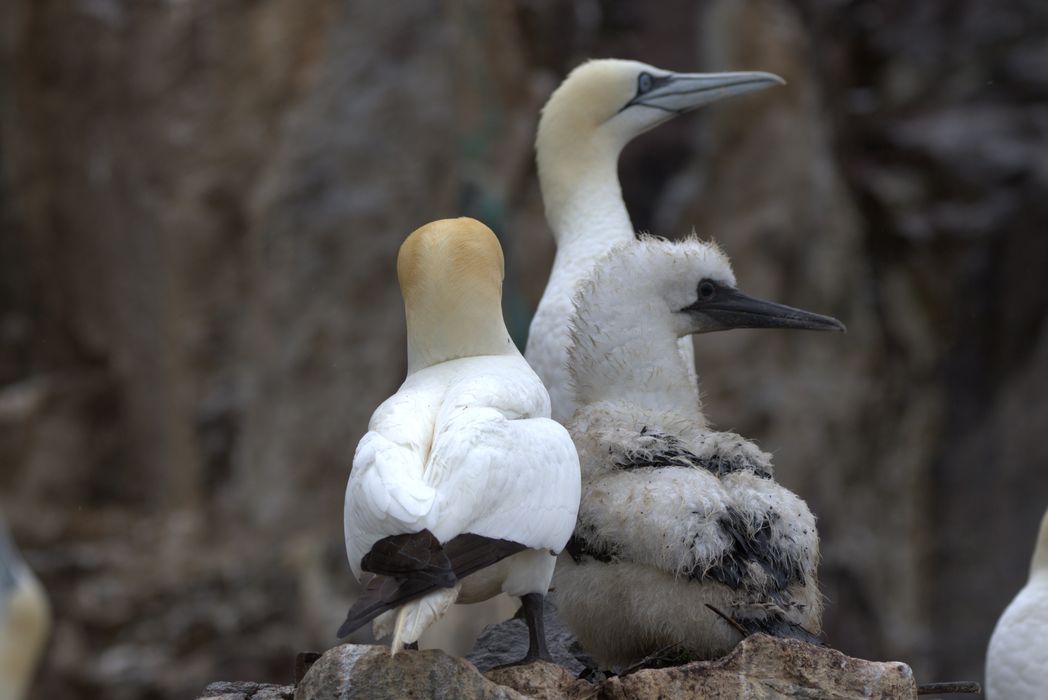
A pair of gannets with a chick
In their statement accompanying the refusal of the license, NatureScot said that they had considered if the hunt contravened any animal welfare legislation. After receiving assurances from the hunters, they were satisfied that it did not. There has never been any independent monitoring of the killing method.
So, there I was, on the Bass Rock, a very similar rock to Sula Sgeir, surrounded by thousands of gannets and their chicks. I’d just heard that NatureScot had refused a license for the 2026 hunt. That’s great. But what about next year or the one after? If NatureScot can’t refuse a license when the Government’s own Animal Welfare Committee says the hunt is inhumane what’s to be done?
The answer is that the unique loophole in the Wildlife and Countryside Act (1981) that allows for gannets to be killed on Sula Sgeir needs to be removed. The League Against Cruel Sports and our friends at One Kind have written to the Environment Minister, Jim Fairley, asking to meet and discuss a timetable for this to be done.
From my time on the Bass Rock I learnt that gannets are beautiful birds that like to squabble. In the midst of their tightly packed colony, they defend their tiny territories and protect their chicks with an unenviable tenacity and aggression towards even their immediate neighbours. Theirs is a long life of struggle. As Maggie said, they occupy a fragile ecosystem. Surely, we can help them on their way without using centuries old methods to kill them for a local delicacy?