

Neosporosis – a disease risk to farmed cattle from hunt hounds
Posted 10th June 2026
A guest blog by Dr Sean Wensley looking at the links between hunt hounds and a disease affecting cattle on British farms.
Dr Sean Wensley is a senior vet, with over a decade's experience spanning veterinary practice, charity work and academia. He has previously been President of the British Veterinary Association.
What is neosporosis?
Neosporosis is a disease caused by a parasite, Neospora caninum, and is a leading cause of abortion in UK dairy herds. As well as potentially aborting their calves, cows infected with Neospora often experience ongoing reproductive problems, resulting in many being culled due to reduced milk yields and the increased cost of trying to get them back into calf.
How is neosporosis in cattle linked to hunt hounds?
Understanding the link between hunt hounds and neosporosis in cattle requires an understanding of the parasite’s lifecycle.
The main part of Neospora’s lifecycle is through dogs. When dogs become infected, the parasite reproduces and is then passed out in the dog’s faeces.
Neospora typically enters a cattle herd in one of two ways:
- By cattle eating infected dog faeces. Dogs on farms include farm dogs who live there and roam freely around the cattle yards and fields. They also include passing dogs who cross fields where cattle graze; these passing dogs can include family pets out on a walk and, on farms near hunts, hunt hounds.
Dogs from any of these groups may defaecate and contaminate the cows’ feed, water or grazing pasture with their infected faeces, but hunt hounds pose a particular risk because of their diet.
- By a farmer inadvertently purchasing infected cows and introducing them to the herd. When these cows become pregnant, if they do not abort, they can instead transmit the parasite to their unborn calves. Cows can infect unborn calves in this way over several pregnancies, and their calves, who are also infected for life, can also transmit it to their own offspring in later life. This can cause the disease to remain in a herd across multiple generations.
There is no cure or vaccine for neosporosis, and the disease cannot be passed to people.
Of these two transmission routes, cow-to-calf transmission becomes an underlying health problem in the herd, causing intermittent abortions over a longer period of time. Whereas, if there is an infected dog, or dogs, on the farm, this can cause an ‘abortion storm’, with multiple abortions happening over a short space of time.
Why do hunt hounds pose a significant risk to cattle because of their diet?
The types of food typically fed to hunt hounds increases their risk of becoming infected with Neospora.
When dogs infect a cattle herd with their contaminated faeces, it is because the dogs have first become infected themselves. This happens when they eat animal materials, such as placenta or tissues from aborted calves, that are infected with Neospora caninum. It can also happen if they eat meat from Neospora-infected deer.
Of the three types of dogs that would most commonly be on a cattle farm – farm dogs, family pets and hunt hounds – it would be unlikely for most family pets to encounter these infected animal materials. Faeces from family pets are also more likely to be picked up and disposed of, further reducing risk. The permitted walking of pet dogs across grazed pasture, coupled with faeces disposal, is therefore likely to pose a low neosporosis risk to cattle.
A farm dog living on a cattle farm with potential access to calving areas, may eat placenta and other infected materials that are present following an abortion. Living in close proximity to the cattle, farm dogs can then defaecate onto the cows’ feed, pasture or drinking water and this is an important risk.
Hunt hounds who come through farms and onto farmland grazed by cattle have a significant risk of being infected with Neospora, because the hounds are typically fed dead animals (so-called ‘fallen stock’) that are collected from multiple local farms and taken to the hunt kennels. Like farm dogs, hunt hounds, while running through a farm, may access calving areas and eat infected birth materials like placenta. But in addition, their diet may also routinely include placenta and aborted calves collected from local farms, which increases the chance of their diet being infected with Neospora. Additionally, hunt hounds may eat carcases of local wild deer, who can also be infected with Neospora.
While carrying this high risk of infection from their diet, hunt hounds on a farmer’s land may then defaecate and contaminate the cows’ feed, pasture or drinking water with the parasite.
How can neosporosis be prevented?
Prevention of neosporosis requires thinking about the two routes of transmission:
- To avoid introducing potentially infected cows to a herd, the farmer should introduce measures such as minimising the number of new cows that are bought in from outside the herd. For any cows that are bought in, they should preferably be blood sampled at the farm of origin and not purchased if they are found to have antibodies to Neospora. If this is not possible, new animals should be blood-tested on arrival.
- Avoiding contamination by dog faeces has two aspects.
First, all dogs should be prevented from accessing calving areas and anywhere where there could be placentae, dead calves or other birthing materials. Additionally, these materials should be removed from calving areas as soon as possible to a secure location, inaccessible to dogs. These are measures to prevent dogs from eating infected material.
Secondly, dogs should, where possible, be kept out of fields that are used for grazing by cattle or for the production of cattle feed. This is to prevent dogs who may be infected with Neospora coming onto the pasture and contaminating it when they defaecate.
Hunt hounds pose a neosporosis risk that is difficult to manage
Where a farm is near to a hunt, it can be difficult to keep hunt hounds off fields used for cattle grazing. If the hunt is passing through, hounds may cross grazing pastures and even access farm paddocks that could include calving areas. As well as the difficulty in preventing access for hunt hounds, the hounds are at a higher risk of carrying, and therefore spreading, Neospora because of the dead calves and other dead animals that they are commonly fed. Cattle farms with active hunt packs coming onto their land are at greater risk of infection with Neospora.
Farmers near to hunts live with a heightened risk of neosporosis in their cattle
While neosporosis is a leading cause of abortion and economic losses on cattle farms, the role of dogs in introducing the disease should not be overplayed. Most new cases of neosporosis in a previously healthy herd are a result of new, untested cows having been bought in.
That said, the role of transmission by dogs cannot and should not be ignored. While practical measures can be taken to minimise risk from farm dogs and family pets, hunt hounds can be difficult to keep off farmland and they have a heightened risk of carrying the disease.
‘Hunt havoc’ describes the range of disruption, damage and safety hazards caused by hunting parties that is experienced by some farmers and rural communities. Alongside the potential trespass, property damage, road disruption and livestock worrying that fall within the hunt havoc complex, cattle farmers near hunts also live with a heightened risk of their cows becoming infected with Neospora.
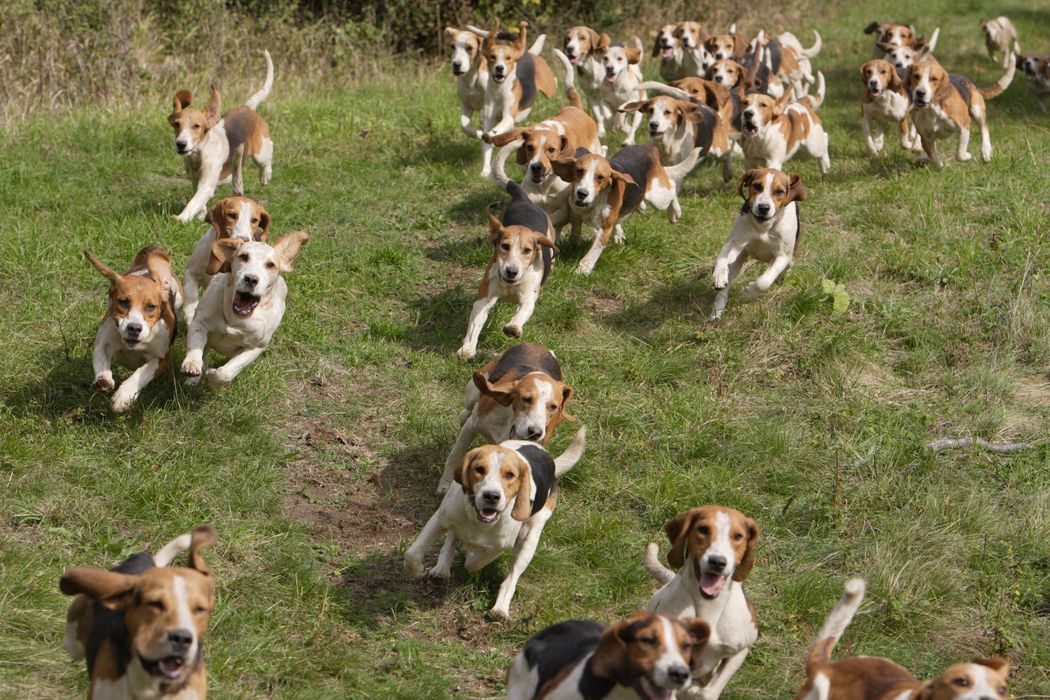
Hunt hounds on the run